

Overview –
Now days with the new car features coming in, it sometimes become confusing for the end user, well one such feature is heads up display which is not so common feature in all the cars yet certain newer models come. Today in this article we are going to tell you what exactly is the Heads-up display and how does it help.
Heads up display is a transparent reflective display that provides with all the essential & crucial information along with the data that is needed while driving avoiding the distractions.
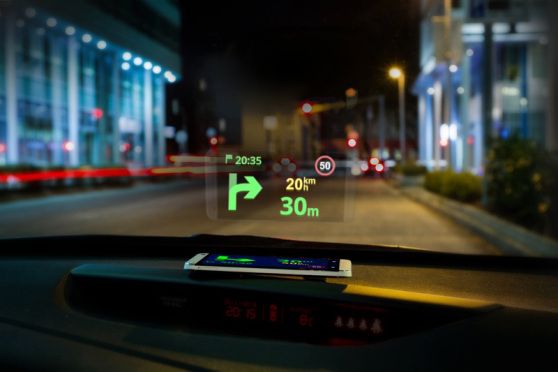
The modern heads-up display displaces information such as navigation, speed, Tyre pressure etc.
The origin of the name stems from a pilot being able to view information with the head positioned “up” and looking forward, instead of angled down looking at lower instruments. However, the modern car tech gets its name from the position it allows the driver to be in.
Components used –
Heads up display comprises of a projector unit which is an optical collimator setup that includes a convex lens or concave mirror with a cathode ray tube light emitting diode display or liquid crystal display at its focus.
Second component used is the combiner which is typically an angled flat glass that redirects the projected image from projector in such a way as to see the field of view. Combiners may have special coatings that reflect the monochromatic light projected onto it.
And the very last component used is the computer that provides the interface between the HUD (i.e., the projection unit) and the systems/data to be displayed and generates the images and symbols to be displayed by the projection unit.
There is variety of customization options available whether it is the looks, themes or the information that you would like to be displayed for your connivance.
Types of HUD –
We can see the variety of HUD displays. The most common is the fixed mounted. As the name says it is mounted at a fixed position.
The second type includes head-mounted displays- is a display device, worn on the head or as part of a helmet that has a small display optic in front. It includes the helmet mounted displays.
Many of us might think, that HUD can be fitted additionally., well the answer to this is yes, we can get the heads-up display fitted additionally. Certain manufacturers also offer night vision information in display.
Various automobiles have used the heads on display feature since 19th century such as the General Motors, in the year 1988 their first HUD units were installed on Oldsmobile Cutlass Supreme Indy Pace Cars and replicas. Optional HUD units were subsequently offered on the Cutlass Supreme and Pontiac Grand Prix before being more widely available. 10 years later in 1998 The first color display appeared on the Chevrolet Corvette again in 2003 BMW had introduced it in E60. Some systems, such as those used by BMW, also include entertainment functions into the head-up display. It will display radio stations or your song list as you scroll through them using a button on your steering wheel.
Having an overview of Hud let us now know what makes it smooth and easy.
Eyes-on-the-Road-Benefit,
–also known as the Head-Up-Display-Advantage, this system stems from increased situational awareness and thereby increasing reaction time to external hazards, such as pedestrians.
virtual reality –
Eyes-on-the-Road-Benefit uses the virtual reality driving simulators to mimic real life driving scenarios while eliminating situational variability.
Third factor is the reaction time,
The feedback offered by an HUD is projected onto the windshield of a vehicle with the aim of integrating outside stimuli and the instrumental feedback; thus, removing the need to remove a driver’s eyes from the road The reaction time to hazards in HUD are faster compared.


